During this term, we spoke about the importance of feedback to improve performance and student learning; a study investigating the motivation of student to provide feedback, discussed how “obtaining feedback from students provides teachers with opportunities to improve the classroom teaching and learning experience while it is occurring” (Caulfield, 2007).
The feedback and subsequent data for this classroom action research project, was collected via a questionnaire, using Microsoft Forms with focus on the overall evaluation of the CAR as experienced by the students, and benefits as it relates to their academic research and subsequent writing. I provided the questionnaire to the students one week after the activity in-class, as well via email. This allowed enough time for students to post on Padlet, and review other student’s contributions.
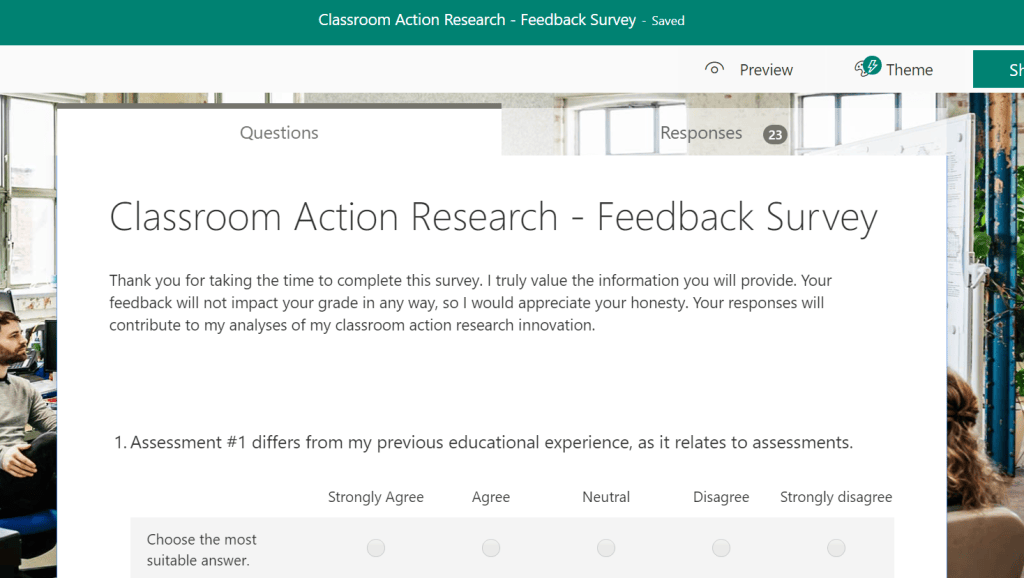
The survey itself is based on the Likert scale, with an open ended questions at its conclusion. I included the survey sample below. I received 23 responses, which equates to a 82% completion rate.
Based on the data collected, I wanted to review and evaluate success based on student’s feedback about the experience, and if it benefited them in their academic research and writing. I have also since graded the assessments, which allowed me to gauge if there was an increase in quality of research, content and academic writing. And finally, my measure of success also related to students having another tool to allow them acclimatize to the Australian classroom, feel supported and collaborate with each other to enhance their educational experience with BMIHMS at Torrens University.
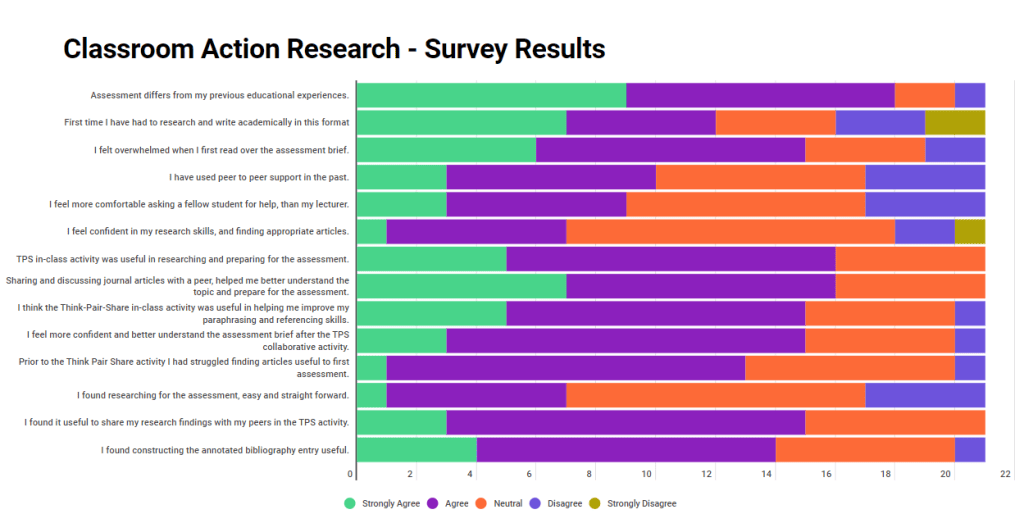
The data suggests that majority of students agreed that their first class assessment differed from their previous educational experience, and though some had researched and written academically, many still felt overwhelmed when they first read the assessment brief. Survey results also indicated that students find paraphrasing a challenge, which is also evident in the number of plagiarism cases I handle each term.
Some students had used peer support in the past, and there were mixed results as it related to if students felt more comfortable speaking to fellow student or lecturer for help. Generally speaking students did not feel confident in their research skills and majority found the Think-Pair-Share in-class activity was useful in researching and preparing for assessment #1. Students also felt that sharing and discussing journal articles with a peer, helped me better understand the topic and prepare for assessment #1; as well as finding it useful in improving their paraphrasing and research skills.
The most promising results were the agreeable response to the question relating to increased confident and better understand of the assessment brief after the Think-Pair-Share collaborative activity. Given the number of students who conveyed their struggle with research and finding suitable articles for the assessment, this innovation has seemingly provided some positive results due to the peer collaboration.
Students shared their feedback in the open text box, and again generally the feedback was positive, with some constructive comments as well.
“To share everyone idea in classroom help to know other thinking about content” – Anonymous
“It is a great experience to work with other mates” – Anonymous
“With think-pair-share activity, students need more time to read and analyse the articles together.” – Anonymous
“I need more time to do research and discuss with my partner.’ – Anonymous
Based on the feedback, survey results, and online Padlet posts, the innovation seems a mild success, specifically related to using peer collaboration, which increased understanding of the assessment brief and content. I have since graded the assessments, that this CAR related to – and though I found a higher quality in academic journals, minimal improvement of academic writing was noted.
References:
Caulfield, Johnette (2007) “What Motivates Students to Provide Feedback to Teachers About Teaching and Learning? An Expectancy Theory Perspective,” International Journal for the Scholarship of Teaching and Learning: Vol. 1: No. 1, Article 7.
Available at: https://doi.org/10.20429/ijsotl.2007.010107

