In this study and related research, focus was placed on international student’s engagement in collaborative learning to improve their academic writing. The studied benefits of collaborative peer learning includes increased knowledge base, and is associated with deep rather than surface approaches to learning, resulting in important higher learning skills such as critical thinking, intellectual interest, as well as communication and information management skills (Ambrose, et al., 2017); leading to increased student learning (Abdi-Rizak, 2008). Ultimately, collaborative peer learning encourages students to engage in content and higher order thinking which could greatly benefit international students’ academic writing and more importantly the understanding of the content.
During the first unit of the GCLT, we delved into active learning, as a teaching method and its importance in the classroom; a video that I discovered allowed me to understand this methodology and the value of integrating into the classroom. The video, created at McGill University; focused on classroom design as it relates to active learning, what I found most interesting was the round table discussions as the basis of the class; which fostered team work, student interaction, and most importantly the building of confidence in students who would otherwise not contribute or benefit from peer-to-peer learning. These type of active learning activities could foster student’s abilities to share their own thoughts and opinions, without fear as they embark on their education journey (Fraser, 2011)
Based on this research and my own interest into the positive benefits of peer collaboration, I opted to use this teaching methodology to address my challenge. Prior to this particular class, I asked students to bring (2) two academic journal articles that they had individually researched for their first assessment; then in class, they were partnered with another students an asked to discuss all (4) four articles with their ‘pair’. The students were then asked to choose (1) one of these articles, the one that they thought would be most beneficial as it related to the first assessment, and then write a annotated bibliography for the chosen article. Each ‘pair’ then posted their submission on Padlet (the digital innovation utilized). The digital tool is also an important element of my CAR, as they can be “useful in a teaching and learning context for supporting dialogue…collaboration….and student reflections” (UNSW Sydney, 2014).
The aim with this innovation was to assist students three-fold; first to allow them to discuss and learn in a Think-Pair-Share format, then to understand the concept of writing an annotated bibliography (improving academic writing and referencing) and then through the sharing of these articles with the class, provide students with several academic research journals to use for their first assessment.
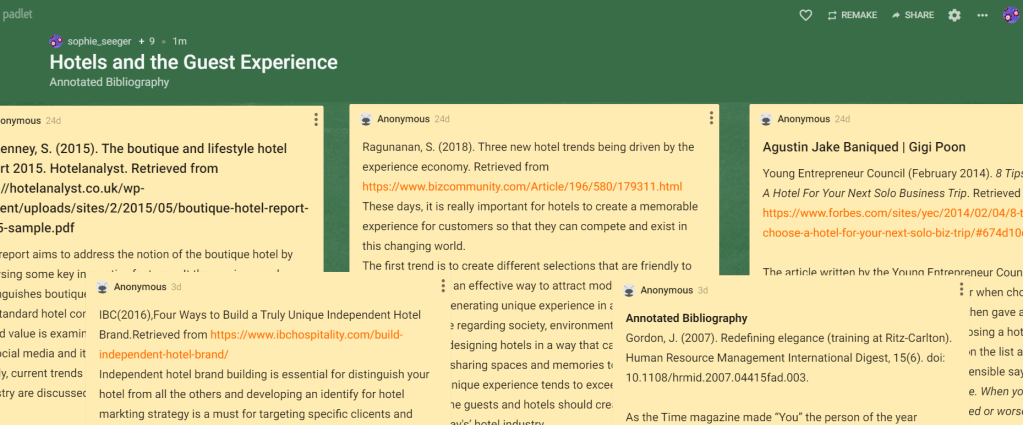
Below is a sample screenshot of the Padlet, where there was a total of (9) posts; therefore 18 students actively engaged in the classroom teaching strategy; which equates to 64% of the class.
References:
Abdi-Rizak, M. (2008). Effects of active learning variants on student performance and learning perceptions. International Journal for the Scholarship of Teaching and Learning, 2. doi:10.20429/ijsotl.2008.020211
Active Learning Classroom: Everyone’s engaged (2011). McGill University. Available https://www.youtube.com/watch?v=H7xidmVt0uE
Ambrose, M., Murray, L., Handoyo, N. E., Tunggal, D., & Cooling, N. (2017). Learning global health: A pilot study of an online collaborative intercultural peer group activity involving medical students in australia and indonesia. BMC Medical Education, 17 doi:http://dx.doi.org.ezproxy.laureate.net.au/10.1186/s12909-016-0851-6
UNSW Sydney (2014). Blog, Wiki or Forum – which should you use? Support for staff building online or blended courses. Available: https://teaching.unsw.edu.au/assessment-blog-wiki-or-forum-which-should-you-use

